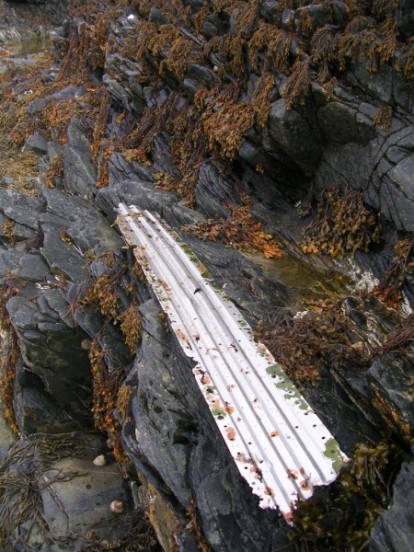
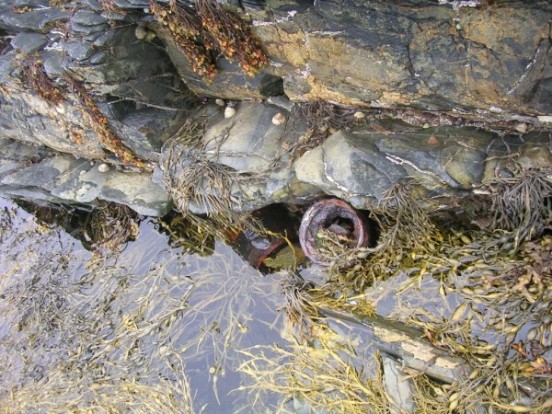
Supermarine Sea Otter Mk.2 JN246 of the Eglinton Station Flight, RN, landed at sea off Colonsay and was then driven ashore and destroyed on Ardskenish Beach on the 10th/11th February 1949

| James William Wickham | Lieutenant | Pilot | Survived |
| ? | ? | ? | Survived |
I guess this is where visiting aircraft wrecks and ship wrecks overlaps, as the aircraft was an amphibian and the wreck lies in the inter-tidal range, though it does not entirely dry at low tide.
For a long time the identity of this aircraft remained a mystery, however this was answered in 2015 by a former crew member of HMS Creole, a Londondeery based C Class destroyer which had taken part in the attempt to save the aircraft.
The aircraft belonged to the RNAS Eglinton Station Flight and had been despatched on a Search & Rescue flight after Barracuda Mk.III ME261 of No.815 Sqn, also stationed at Eglinton, ditched at a position reported to be some 10 miles south of Rinns Point on Islay on the 10th February 1949. The crew of that aircraft had taken to their life raft, however in February their survival time even in a raft in the North Atlatic was fairly short. A Halifax was also sent to the area and its crew were the first to sight the dinghy containing the crew of ME261 7 miles North East of Rinns Point, but had difficulities themselves which resulted in them declaring a Mayday and landing at Port Ellen. When JN246 arrived overhead the crew of the Barracuda had been in their life raft for 2hrs 40min and as it was not certain how soon the closest surface vessel would arrive and so the pilot of the Sea Otter, Lt Wickham, landed in the open sea to pick up the survivors from the raft. This was carried out successfully, but the sea was too rough for the Sea Otter to safely take off again. In the meantime a number of vessels had been ordered to the area to assist, one of these was HMS Creole from whose ship’s company the lead came from which identified this aircraft, also involved were HMS Loch Fada and HMS Thermopylae. HMS Loch Fada was a Loch Class frigate of the Londonderry Flotilla while Thermopylae was a T-Class submarine based in Holy Loch. Aircraft were requested from Ballykelly and the lifeboats at Portrush and Port Ellen were ordered to sea, merchant shipping in the area was notified and asked to assist if they could.
The Sea Otter was spotted at 15:30 by Creole and by 15:50 they had launched a boat to take off the survivors from the Barracuda who were transferred to HMS Loch Fada. The original plan was to take them aboard HMS Creole but once they were aboard Loch Fada asked to stay where they were and be taken back to Northern Ireland. After this the attention of HMS Creole switched to trying to help the crew of JN246 get airborne again. Creole requested that Loch Fada pump oil into the sea upwind of the aircraft in an attempt to calm the swell to make a take off easier but this did not work. At 17:10 the crew of JN246 were passed a message ordering them to attempt to taxi the aircraft under its own power to Loch Indaal but only eight minutes later they radioed asking to be taken off.
After the crew of JN246 were taken aboard HMS Creole attempts were made to take the aircraft under tow but the swell prevented a line from being secured to the aircraft and so all HMS Creole could do was stand off hoping that conditions would improve. During this time the aircraft had been drifting in the wind in a northerly direction and was eventually driven towards Colonsay during the night. At first light on the 11th the Sea Otter was sighted but by this time it was up on the shore at Ardskenish and so HMS Creole returned to Londonderry. The aircraft had been relatively undamaged by its landing at sea, there was possibly some wave damage, however once ashore it was soon severely damaged and became broken up.