
Avro Anson Mk.I LT184 of 7 Air Observer School, flew into Mynedd Perfedd on the 4th / 5th October 1943
Avro Anson Mk.I LT116 of 9 (O)AFU flew into Mynedd Perfedd on the 8th June 1944
The accidents that befell these two aircraft occurred nearly one year apart, however the proximity of the two crash sites to each other prevents positive identification of either site, especially as they came from the same production block at Yeadon. However there are identical parts from three undercarriage units on the hill which allowed us to determine that we had found the crash sites of both aircraft and not just wide scatter from a single aircraft. There are two distinct wreckage trails with some degree of scatter on the scree in between.
LT184
| John George Shepherd | Sergeant | Pilot | Killed |
| Edwin John Keightley | Sergeant | Wireless Operator / Air Gunner | Killed |
| John Chrystal | Leading Aircraftman | Navigator (U/T) | Killed |
| John Thomas Key | Leading Aircraftman | Navigator (U/T) | Killed |
LT116
| Peter Selwood Sullivan | Flight Sergeant RAAF | Pilot | Killed |
| Malcolm James Mott | Flying Officer RAAF | Navigator | Killed |
| William Donald Nelson McKessock | Flying Officer RCAF | Air Bomber | Killed |
| Harold Jackson Fletcher | Warrant Officer RAAF | Wireless Operator | Killed |
| Leonard John Pearce | Sergeant RAFVR | Wireless Operator | Killed |
The first aircraft to crash on Mynedd Perfedd, LT184, was on a navigation exercise from Bishops Court, in Northern Ireland, when it crashed high on Mynedd Perfedd killing all onboard. The crash was reported to the Mountain Rescue Service at Llandwrog at 00:15 on the 5th October. At first the report was treated cautiously as no aircraft had been reported missing in the area and the Royal Observer Corps had not reported any plots in the North Wales region. A report came through from Bishops Court informing Llandwrog that one of their aircraft was missing, at around the same time a message was received from Wigtown which stated that they too were missing an Anson.
The MRT set up base at Maes Caradoc in the Nant Ffrancon pass and proceeded up onto Mynydd Perfedd, at 04:00 they heard the sound of metallic wreckage falling from the cliffs, a search of which was carried out but nothing was seen. The team then returned to the foot of the mountain to wait until day break before continuing the search. They returned at 06:30 and had located the crash site by 09:30 and the crash site was confirmed to be that of the missing aircraft from Bishops Court. The bodies of the 4 crew were brought down following some difficulty in extracting them from the twisted wreckage and the MRT returned to Llandwrog at 16:30 the same day.
———-
The second aircraft to come to grief on Mynydd Perfedd, LT116, was based locally at Llandwrog near Caernarfon, this aircraft was on a similar exercise to LT184 when it flew into the same area of the mountain that LT184 had struck several months earlier, this time with the loss of five crew. The crash had been heard by a farmer who lived in the bottom of the valley at 04:00 he then reported it to the local Police. The RAF MRT from Llandwrog proceeded to Maes Caradoc and climbed up onto the mountain, on this occasion they quickly located the site and had returned to base for 16:00.
The Operations Record Book for No.9 (O)AFU records that LT116 was badly broken up but there were no signs of a fire having occurred after the crash. Based on this alone it would possibly mean that LT116 is likely to be the western of the two wreckage trails. However this is unlikely, especially given how quickly the crash site was found, less than 3 hours after the MRT had been called, and that it was fairly accessible would suggest the eastern of the trails, we were able to follow it up much further than the other trail. LT184 was recorded as being in a gully on the cliff face and it took two separate searches to locate which suggests that it is the western of the two crash sites. Edward Doylerush also came to this conclusion in Legend of Llandwrog.
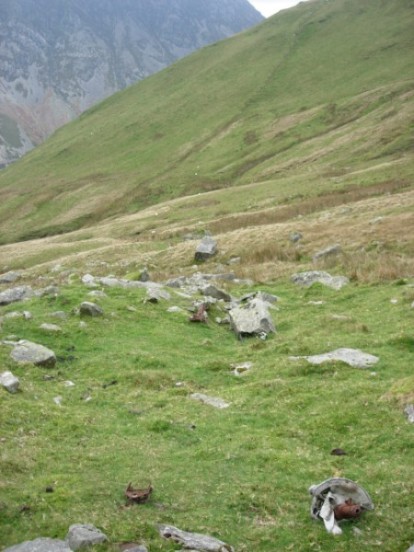
Below are photographs from the first (eastern) wreckage trail.



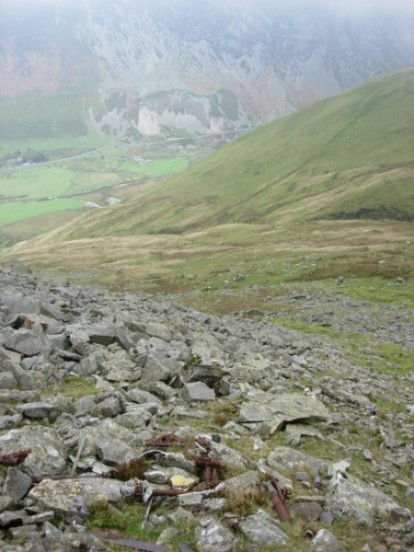
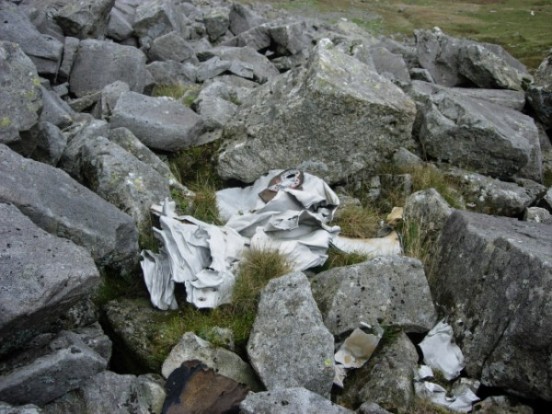
Below are photographs from the second distinct wreckage trail, to the west of the first.



The Commonwealth members of crew from LT116 were buried at Chester (Blacon) Cemetery, while all of the British casualties were buried at various cemeteries throughout the UK.


