de Havilland Vampire F.B. Mk.5 VV602 of No.613 (City of Manchester) Squadron, Royal Auxiliary Air Force

A Vampire Mk.3 at the RAF Museum, Hendon, outwardly similar to a Mk.5
|
Crew / Passengers |
Rank - if applicable |
Position e.g. Pilot |
Status |
|
Jocelyn Francis Baverstock Davis |
Flying Officer SAAuxAF |
Pilot |
Killed |
The aircraft was an English Electric built example of the Vampire F.B. Mk.5 and was equipped with the de Havilland Goblin Mk.2 centrifugal flow turbojet. It had been built at one of English Electric's two sites near Preston and was completed on the 2nd February 1949. At the time of its loss the aircraft have accumulated a little over 486 hours of flying time.

The crash site is clearly marked by a deep depression in the corner of the field, this photo was taken during the pre-dig survey in June 2008.
On the day of the accident, Saturday 1st May 1954, two Auxiliary pilots, Flying Officer Parker (Blue 1) and Flying Officer Davis (Blue 2), had been briefed to carry out a Cine Gun Exercise over the North Sea at an altitude of between 20,000 and 25,000 feet. They had been due to take off at 11:30 but had been delayed until 12:45 by thundery showers. The weather was recorded as having been a mixture of Stratus and Cumulus clouds with the base at 2,000 feet with occasional thunder storms.
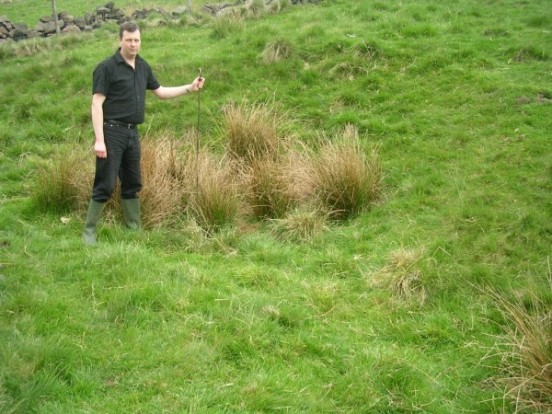
Here Nick Wotherspoon, of the Lancashire Aircraft Investigation Team, marks the crater with a probe rod.
The flight were given permission by the Tower at Ringway to take off from Runway 24 at 12:46 and they took off as a pair. As they climbed away from the airport they turned onto a magnetic heading of 120o. They entered cloud as expected at 2,000 feet, this turned out to be light, layered cloud in which it was easy to maintain formation in. Shortly after this the two aircraft entered they entered a much darker area of cloud with heavy rain and moderate turbulence. At around 6,000 feet Flying Officer Davis radioed Flying Officer Parker to tell him that he was breaking formation. The only logical reason for this was he had lost sight of his leader in the cloud and was taking appropriate actions to avoid a mid air collision. The stated he was turning onto a heading of 140o. According to the investigation F/O Davis radioed moments later to say he was bailing out of the aircraft, it was stated from analysis of recordings made at Ringway that there was clear agitation in his voice but no panic.
At the time of the transmission F/O Parker in Blue 1 had climbed to 9,000 feet, he continued to climb until he exited the cloud at 13,500 feet. Once clear of cloud he called F/O Davis on his radio and received no reply. He then reported to loss of his No.2 to the regional Air Traffic Control Centre at Preston. Shortly after this the crash was reported to Ringway by the local Police.

The map above is redrawn from a hand drawn map in the accident report held at the National Archives.
VV602 had been observed once it exited cloud and was seen to dive into the ground near to the northern end of Wildboarclough, some 4 miles south east of Macclesfield and exploded. Shortly before impact witnesses saw a parachute "break away from the aircraft". F/O Davis had managed to abandon the aircraft and had landed almost 200 yards from the crash site but was found to be dead and the parachute was badly damaged. It was concluded that the parachute had opened while F/O Davis was still in the aircraft as the damage and traces of oil and dope were consistent with it having flailed around behind the cockpit before eventually pulling the unfortunate pilot free. He than was struck by part of the aircraft and was killed outright, however had he not been hit by his own aircraft the Court of Inquiry stated that the parachute was so badly damaged it would have most likely not have saved him.
Jocelyn Davis was a South African national and member of the South African Auxiliary Air Force, he was seconded to 613 Squadron from the City of Johannesburg Squadron. He had been in England since 1951 and was due to return home in September 1951. While in this country he was undertaking an engineering apprenticeship at Metropolitan Vickers in Manchester, this was due to be completed by September 1954. The Officer Commanding No.613 Sqn wrote "the circumstances of this accident bring to us most forcibly that auxiliary pilots must be in constant flying practice". This comment stemmed from the weekend nature of the RAuxAF's flying and not all pilots were able to keep their hours up to a fully proficient standard.
Flying Officer Davis was buried on the 7th May 1954 at Manchester Southern Cemetery following a service at St Winifreds Presbytery in Heaton Chapel.
Following a visit to the site in September 2007 a licence was applied for to permit the excavation of the crash site, this was granted within a month. Due to the winter, wet spring and other commitments it was not until early summer that we got around to organising the dig.
After a final visit to the site to survey it with deep seeking metal detectors an excavator was hired in for a day and the group gathered on the 28th June 2008 along with a Volvo mini digger to excavate to the site.

The excavation begins, Gareth starts by removing the turf and top soil.
The plan for the dig was to concentrate on a large signal that had been discovered within the crater, after the top soil had been removed the usual decayed aluminium "daz" was found. Within a couple of feet the first sizable item was discovered. This was made from stainless steel and although we were able to move it was connected to something else which prevented it from being removed from the hole. More soil was then cleared with the machine which again struck something substantial about 3 feet uphill from the first piece. At this point the shovels moved in and began clearing this item to find its edges, and then we used the digger, this time with a narrow bucket, to clear soil out from around it. The piece proved to be a large, and squashed, section of stainless steel and was obviously from the Goblin engine and it was also connected to the other item. Attempts were made to shift it by hand but it was too heavy so the machine was brought in again with a lifting strop to haul it out.

The first large piece is uncovered.
Once we had got it turned over we were able to see for the first time the rear most part of the engine, this item had been thrown back into the hole at the end of the RAF's clear up operation as it, and pieces found in 1988, were up side down in the hole. The cone which sits within the jet pipe was straight and only showed slight pitting around its tip.

This proved to be the only large piece of the engine left in the crater. It may not look that large and heavy in this photo but it took four people to lift it into and out of the trailer to get it away from the site.
Once we had the large piece of engine out we continued to clear the crater with the digger, pausing every so often to lift out pieces which were spotted. We stopped at about six feet when clean shale was encountered, this had been our estimate of the maximum depth the original crater would have gone to. The digging then continued solely by hand to uncover as many small items as possible. A number of vanes from inside the engine were found, as were fragments of the instrument panel, but no instruments. It was reported that none had been found at the time of the crash either, the assumption that was made was that they had been destroyed in the crash, and this would seem to be true. Other items that were found included a mass balance from the elevator and shattered pieces of armour plating. A large signal that we found on the edge of the crater turned out to be a large and very heavy lump of lead, that would once upon a time have been a ballast weight.

Digging continues by hand after the crater had been partly filled.
Just to one side of the crater we found a large magnetometer contact during out previous visit to the site, after having concluded that no more big items were going to come from the hole a couple of the group set about finding this once more. It did not take long as the digger having rolled across the area had flattened to the soil just enough for the top of the item to be showing above the surface. This was then dug out by hand, at first it was thought it looked like a 20mm cannon, but then it was so twisted we thought it couldn't be one and was possibly an undercarriage leg. Once more of it was clear it was obvious to those of us who had been on digs before that the first guess was correct. A strop was put round it and it was then lifted clear of the ground by the digger. We were amazed by the level of damage that it had suffered, on occasions the barrel may be bent but this cannon had been literally bent in half and the breach was completely smashed with almost all of the internal workings missing.

This is what became of the cannon when it hit a wall and was then hit by a Goblin engine from behind.
The excavation was brought to a close once all of the more substantial magnetometer and deep seeker contacts had been explained and the site was covered over again. The recovered parts have been removed for cleaning and sorting.

The site once we had finished all of our work.
Photographs of some of the cleaned parts are on the next page.